


WHO WAS SAINT VINCENT de PAUL
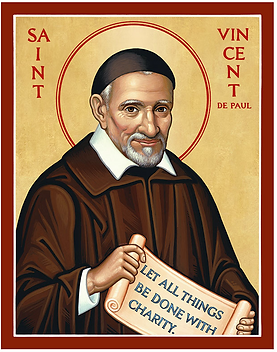
St. Vincent de Paul, the patron saint of charitable societies, is known for his compassion and charity towards the poor. He was born in the French village of Pouy on April 24, 1581 and raised by a poor peasant family.
He was ordained in the year 1600 and spent some time in Toulouse. In 1605, while aboard a ship traveling Marseilles to Narbonne, he was captured, taken to Tunis, and sold into slavery. After two years, he successfully escaped and returned to France.
St. Vincent then went to Avignon and later Rome to further his studies. During that time, he became a chaplain to the Count of Goigny and was responsible for distributing funds to the needy. He briefly served as pastor of a small parish in Clichy while also tutor and spiritual director. From then on, he dedicated his life to preaching and aiding the poor.
CHURCH HISTORY

A modern brick church in a mixed Gothic style built to serve the northern part of the 1920s London County Council Becontree housing estate. The interior is dominated by the late 1980s reordering and the sanctuary with its elaborate 1940s reredos is unfortunately obscured by a screen inserted at this time.
St Vincent’s lies in the northern part of the LCC’s huge Becontree housing estate, which was developed from the 1920s. The first church, a temporary building, was built in 1923. In 1927 the parish was erected and the first resident priest appointed; the presbytery may date from this time. A parish hall was built in 1929. In May 1933 the present church was opened. It was built from designs by Geoffrey Raymond of Scoles and Raymond. The church was consecrated in December 1973. In 1989 the sanctuary was reordered by Richard Hurley of the Dublin firm of Tyndall Hogan Hurley.
Description
A large church built in dull red brick with stone dressings and roof coverings of concrete tiles. On plan the building comprises an aisle less nave with a western narthex, a small south western baptistery and a short sanctuary narrower than the nave. The building is in a mixture of Gothic styles. The single-storey narthex has canted sides, three large pointed doorways with small paired windows between and a stepped parapet with stone coping. In the tympanum of the main west door is a carved and painted stone and mosaic depiction of Sacred Heart. Behind rises the tall west gable which is set forward slightly from the body of the nave and has a large five- light window with slowing tracery and a triple-trefoiled window in the head of the gable above. The outer parts of the west end wall are blind and have crow-stepped rooflines continuing the main gable. On the north side the crow-stepping is continued down on a projection housing the gallery stair. The side elevations are divided into five bays by plain buttresses and in each bay is a large rectangular window of three lights with a hood-mould over set high in the wall. The parapets are stepped up over the buttresses.
Internally the nave is one large space with a boarded and painted hammer beam roof. The walls are plain plastered and the floor is parquet. At the west end is a timber organ gallery with a passage below. The windows are all clear glazed. Many of the leaded lights were apparently replaced after bomb damage in World War II. In the north wall is a small recess with a side altar and a statue of St Vincent de Paul dating from 1949. At the east end a tall pointed arch opens into the sanctuary, which has a boarded pointed ceiling, windows in the side walls and a blind east wall with an elaborate pinnacle reredos made of stone and gold mosaic, with the inscription Sanctus Sanctus Sanctus on the wall above. The reredos apparently dates from 1948. The sanctuary arch is flanked by lower pointed arches leading to the Lady Chapel and the chapel of the Sacred Heart, which have rib vaulted ceilings. In the 1989 reordering a new altar was installed on a broad stone platform at the east end of the nave and the sanctuary was divided from the body of the church by a half-height flimsy-looking timber screen, behind which is a small day chapel. This may be convenient but it is not a happy visual arrangement.
Principal fittings include the nave altar which is a single block of Bath stone carved by Angela Godfrey, a white marble Gothic font of unusual rectangular form and the naturalistic bronze eagle lectern. The remaining timber benches are doubtless original.
Excerpt from Taking-stock.org.uk/building/becontree-st-vincent
INCUMBENTS
1927-1951 Thomas Smith (Ist Parish Priest 1927)
1951-1954 Daniel Harnett
1954-1958 Archibald O'Brien (Parish Priest 1956)
1958-1966 Michael Enright
1966-1987 Michael McKenna
1987-1990 Patrick Sammon
1990-2003 Kieran Dodd
2003-2006 John McCollough
2006-2007 Brian McGilloway (Priest-in-Charge Pro Tem)
2007-2009 Joseph Silver (Priest-in-Charge)
2009 Stewart Foster (Priest-in-Charge Pro Tem)
2009-2017 George Ranahan S.C.A.
2017-2025 Joseph Soosai Marian S.C.A. (Parish Priest 2019)
2025 Hector Rick Fernandez

ASSISTANTS
1929-1931 Vincent Dutton
1931-1932 John Cotter (Cloyne)
1932-1937 John Malachy Byrne (Kilmore)
1937-1940 Francis Branney
1940-1941 John Boyle (Kilmore)
1941-1949 Malachy Kelly
1949 John Boyle
1949-1950 James O'Dea (Killaloe)
1950-1952 Kieran Charles McKeone (Armagh)
1951-1952 James Minogue (Killaloe)
1952-1953 Patrick Whelan (Killaloe)
1953-1954 John O'Driscoll (Killaloe)
1954 Caimin O'Carroll (Killaloe)
1955-1956 Thomas O'Connor
1956-1957 Wilfrid Jolley S.J.
1957-1958 John Campion McDermott A.A.
1958-1962 John O'Callaghan
1962-1966 Denis Ryan
2019 James Joseph S.C.A.